Showing posts with label chickens. Show all posts

Sunday, April 22, 2012

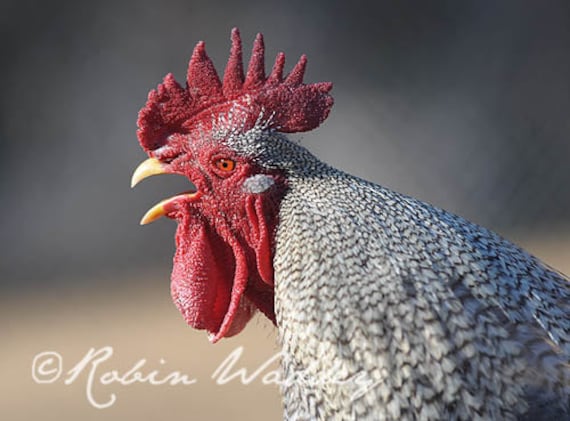
COCKA-DOODLE-DOOOOOOOO

That means "Good morning" in rooster.  I have owned four roosters in my lifetime, they were:  Elvis, Banty, Turkey Lurkey, and Big Red.  I never planned to own any of them. They were all in my chicken yard a result of mistaken chicken sexing. Meaning I bought, or ordered peeps that were "guaranteed" to be all females.  To be fair, it is a difficult,  tedious job and I am sure that there are a few that are misdiagnosed in that process.  And that is why, all four times it happened, I became the unwitting owner of a rooster. 
You may now say, "But I only want hens and don't want the aggravation of a noisy rooster."  And I will say, "Don't own chickens!"  Raising animals of any kind is not a convenience, it is a lot of work that takes dedication and Mick said it best in the line "You can't always get what you want, but if you try sometimes, you get what you need."
I say this because owning a rooster teaches you a lot about relationships, and about yourself. You may wonder how you will know if you have unwittingly become the owner of a rooster.  It will happen when the "peeps" get to be between 3 1/2 and 5 months of age.  It is chicken puberty and when their voices really change from that cute little peep-peep, to more chicken-y vocalizations like clucking and crowing.  One day you may wake up to odd noises that sound a bit like a quiet, "a-hem" -- like a little chicken clearing its throat.  You might even hear it during the day.  The chicks will all be "feathered out" at this point and starting to look a little gawky.  If this sounds familiar, it should because it is the chicken equivalent of humans being 11 - 13, or the canine "puppy uglies" (to be discussed at a later date).  The chicks are beginning to "find themselves".  In the days to follow, the roosters will continue to make many strange sounds, that range from coughing to strangulation.  This is normal.  Think of them as rooster vocal exercises, because they are warming up for the performance of a lifetime -- that will last a lifetime.
By the time they are six months old, the young roosters will fully have their crow on!  Much to the chagrin of you and your neighbors if you/they aren't ready for it.  Once I realized that I owned a rooster, I went to my neighbors and asked if they minded. They all said no -- as long as they could eventually get some free eggs.  The neighbor closest to my chicken yard grew up in an area where chickens ran free in their yard.  He said he found their noises comforting.  Another was from an area of Hawaii where chickens are everywhere, so she was "down" with it too.  So I was on my way to learning about being not only a chicken owner, but a rooster owner too. Now for the more technical -- but still interesting information about rooster crowing and chicken communication:
Most birds sing in some form or another, and crowing is the 'singing' of the rooster. Roosters crow for many reasons including: reacting to a disturbance, reacting to almost any kind of sound (cars, people, other roosters, other animals, etc.), guarding their territory, feeling threatened, if a predator is 'trespassing' on their territory, or just communicating with other chickens.  Roosters and chickens are usually most active in the morning, that is when people notice more crowing. But they can and often do crow 24 hours a day. Roosters crow at daylight because the change from dark to light encourages crowing.  If roosters are kept in a coop that is dark and you turn on a light inside, they will crow when their environment is changed by the light coming on. Often nightlights, floodlights, or other artificial lighting will throw off the animals natural rhythm, and he will crow when it is not daylight/dawn yet (keep this in might if you have motion sensors on your lights).  Light also affects hens, they don't lay eggs at night.  Dawn and the crowing of the rooster activates that response.  Sadly a tactic used by commercial poultry farms is to brightly light the hen houses to get the hens to lay more eggs, it stresses them to produce more eggs.
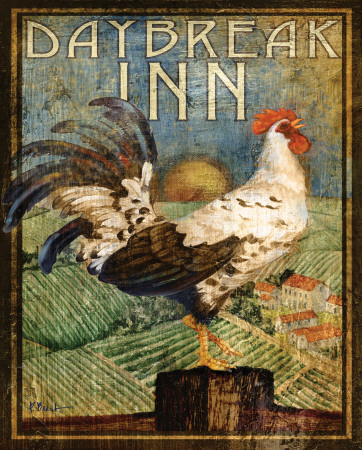
Almost all animals have daily cycles of activity known as “circadian rhythms.” A rooster crows because he has an internal clock that helps him anticipate sunrise. That way he knows when to begin his daily hunt for food and defense of his territory.  If one rooster in the neighbor has an internal clock that’s set a little early, he can stimulate other roosters to crow early too. The rooster’s sunrise song is a way of establishing his territory. When a rooster crows, he’s sending a signal to other roosters that if they trespass, they’re asking for a fight. A rooster will often crow from a vantage point above his territory so he can make others more aware of his presence and so that his songs travel farther. That's why the rooster is so often portrayed in art and cartoons as being perched on the top of a barn a coop or a fence post.
This has been only an introduction to the vast amount of poultry trivia that exists in my brain.  So as not to overwhelm, I will stop now.  I hope you find this informative and educational.  Next time I will discuss Rooster Ego, being "too big for their britches" and egg laying. See you then!


Thursday, April 19, 2012

Welcome to LESLIEpedia! Chickens 101

This is exciting!  I have a friend who calls me whenever she needs information about a variety of subjects from animals to cooking to gardening. I asked her one day why she didn't use the internet and she said, "Who needs it?  I have LesliePedia!"  So that is how the name of this blog came about.  You see, my brain is awash with thousands of bits of information.
  
I suppose that I have always been this way, interested and curious.  Not just in one or two subjects either. I find so many things fascinating. I can't imagine being bored, as there is always so much to do, or learn.  I am an idea person.  I was in business management and marketing for many years.  Now I have  a design studio, LA General Store Design Studio.  I get to let my creative brain roam free!  I love it when a customer comes in with a new challenge, whether it be for an elaborate costume or a wedding dress. My creative juices start flowing, and I never even wonder IF I will be able to create it.  I just start thinking about HOW I am going to do it. 


One day, after a customer placed a very intricate order at my studio, my assistant said, "How are you going to make that?"  I looked at him and smiled and said -- "I don't have the FAINTEST idea, and that is half of the fun right there!"  With the huge amount of information on the internet these days, you can find out nearly anything.  I will admit, however, that it can get overwhelming.  Trying to find out where information is can be quite daunting!


That is why I am starting this blog.  I find SO MANY things so very interesting that I have plenty to share with you in a manner that won't (hopefully) overwhelm you.   I will post a couple of things a day, or every couple of days, and sooner or later you will find a subject or two that might interest you too.  I also welcome questions.  What good is a Lesliepedia, if you can't ask questions?
-------------------------------------------------------------------
So today, let's talk about chickens!!  Have you ever owned a chicken?  I have owned many and LOVED it!  At one time I had a bit of a farm-let where I live in the unincorporated County of Los Angeles.  I was doing the whole "backyard chicken" thing long before it was trendy.  I only raised my hens for eggs, and couldn't have raised them for food!  They were my pets and I kept every one of 'em until they passed.  "Frenchie" was my favorite and the last to go at 12 years+. 


Hen Fact for Today: A hen lives an average of 5-7 years, but can live up to 20 years. She'll lay eggs her entire life, with production decreasing every year from year one. This hen is a Buff Orpington. Once my hens got to be 7 years old, they would only lay eggs in the spring....once they were over 10, they pretty much stopped......kinda like ME!! HA HA. My oldest was a Araucana, who lived to 14. I only raised them for eggs.....the idea of eating one of my lovely ladies -- horrors!
The chickens above are Rhode Island Reds. Did you know In their natural environment chickens are fastidiously clean and preen their feathers everyday?  These Reds are a solid size, beautiful with beautiful plumage. They don't compete with the Silky Chickens that are featured below however!  These chickens are showstoppers and bred more for their looks than anything else, but they are chickens and do lay eggs.  

I could go on and on about chickens and chicken trivia, but I hope not to overwhelm with too much information at one time.  Next time -- I'll blog about Roosters and the latest in modern chicken coops.  The day after that? Maybe gourmet cooking, or couture clothing design, or socializing puppies!!